National Geographic
How 3-D Imaging Helps Archaeologists Preserve the Past | National Geographic
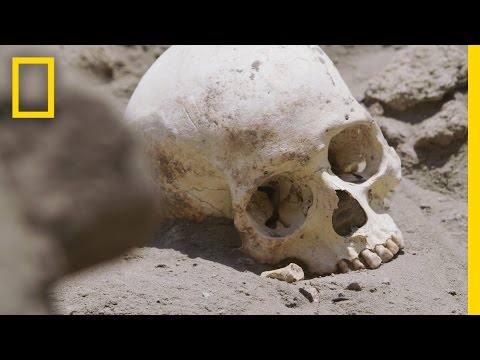
Archaeologist and National Geographic explorer Luis Jaime Castillo and archaeologist Carlos Wester are determined to protect the cultural heritage at the pyramid complex of Chotuna-Chornancap, which was built by the Sicán, or Lambayeque, over a thousand years ago on the north coast of Peru. They are using photography to produce 3-D models of the excavations and where water damage might occur, allowing them to help preserve the sites.
➡ Subscribe: http://bit.ly/NatGeoSubscribe
About National Geographic:
National Geographic is the world's premium destination for science, exploration, and adventure. Through their world-class scientists, photographers, journalists, and filmmakers, Nat Geo gets you closer to the stories that matter and past the edge of what's possible.
Get More National Geographic:
Official Site: http://bit.ly/NatGeoOfficialSite
Facebook: http://bit.ly/FBNatGeo
Twitter: http://bit.ly/NatGeoTwitter
Instagram: http://bit.ly/NatGeoInsta
Archaeologist and National Geographic explorer Luis Jaime Castillo and archaeologist Carlos Wester have been working on the north coast of Peru for decades. They’ve focused on a large complex of pyramids called Chotuna-Chornancap, which was built by the Sicán, also known as Lambayeque, around A.D. 750. The pyramids were a seat of power for at least three civilizations: the Sicán, Chimú, and Inca. The latest major discoveries at Chotuna-Chornancap included the tomb of a priestess who was buried with a gold crown, silver jewelry, and a scepter. “We found the tomb of an elite member of the Lambayeque culture who represents one of the most important rulers we’ve known in this area,” says Wester.
Castillo and Wester are confident that there are decades more of archaeological discoveries to be made at the site, and there is a sense of urgency. “Are we in a hurry? Yes,” Castillo says. “Damage by water, looting, and encroachment are the biggest threat to archaeological sites all around the world,” says Castillo. Hundreds of sites have already been lost. Many of these sites may be small, but Castillo explains why they are still important to preserve: “The problem is that if we go this way, we will end up only having Machu Picchu and maybe Chan Chan and a couple of other very large sites. We want to know how the peasants lived. We want to know how agricultural fields were. We want to answer questions that go beyond how the rich and powerful were enjoying life.”
Today, technologies such as drones make it possible to survey large areas in a short amount of time, and even build models to assess possible site damage. Castillo received a grant from the National Geographic Society to use aerial photography to document El Niño's impacts on archaeological structures such as Chotuna-Chornancap on the north coast of Peru. Using high-resolution, photogrammetric 3-D models to create digital topography allows him to record and assess the extension, duration, and pace of El Niño's heavy rains and floods. Predicting how the water is going to flow makes it possible to try to divert it to protect archaeological sites. “The technical pictures that we can produce can help us do things we've never done before,” Castillo explained. Not only are they able to lay out their excavation units to get a useful bird’s-eye view and produce 3-D models of the excavations themselves, “we realized that the models and the pictures could actually allow us to help preserve the sites much better,” Castillo says.
There are many reasons why it’s important to study and preserve the past. Both Castillo and Wester are motivated by how archaeology can contribute to present and future society. Wester expressed, “The past must become a tool to improve the present, and if we don’t do this, then we are only looking for treasures, and that is not the purpose of archaeology,” says Wester.
GlobalXplorer° is a cutting-edge platform that empowers citizen scientists around the world to help reduce looting and encroachment at important archaeological sites—as well as discover and protect unknown sites—using satellite imagery. Find out how you can become part of the GlobalXplorer° community and make a difference, beginning with our first expedition in Peru, at GlobalXplorer.org. http://www.globalxplorer.org
Read about the discoveries at Chotuna-Chornancap: https://www.theguardian.com/science/2016/sep/10/ancient-tombs-peru-human-sacrifice-chotuna-chornancap
Read Luis Jaime Castillo's bio: http://www.nationalgeographic.com/explorers/bios/luis-jaime-castillo/
Closed-captions are available on the video in English and Spanish.
Senior Producer: Sarah Joseph
Producer: Carolyn Barnwell
Editor: Dave Nathan
Director of Photography: Juan Antonio Puyol
Executive Producer: Vanessa Serrao
How 3-D Imaging Helps Archaeologists Preserve the Past | National Geographic
https://youtu.be/aVB6ocNBhTM
National Geographic
https://www.youtube.com/natgeo
Published Mar 1, 2017