All Cached YouTube Channel Videos

Reset
23,647 videos found Showing 24 on page 367 of 986
Clear Filters
Superships - Giants of the Sea | Full Documentary
52:20
Get.factual
Superships - Giants of the Sea | Full Documentary
🚢 The Future of Superships & China’s Grip on Global Trade! 🚢 Ships transport 90% of the world’s goods, making global trade entirely dependent on these giants of the sea. But as the shipping industry evolves, so do the power struggles behind it. Donald Trump recently claimed that China "operates" the Panama Canal—raising serious questions about Beijing’s influence over this key waterway. Just how deep are China’s ties to global shipping? 🌎 This documentary takes you on an exclusive journey from a shipyard in China, where massive cargo vessels are built, to Rotterdam’s high-tech automated terminal, and even aboard the ALP Striker, the most powerful oceangoing tug in the world. Along the way, we explore the future of shipping, from wind-powered cargo ships to cutting-edge designs using hydrogen and LNG (liquefied natural gas). As international trade faces political tensions, environmental challenges, and groundbreaking innovation, where will these superships take us next? Is the future of global trade in China’s hands? 🚢💰🌍 -- Welcome to the official Get.factual youtube channel! 🌍 We are a documentary streaming channel covering history, science, technology, and nature. Explore worlds distant, forgotten, and unknown; from the depths of ocean trenches to the far reaches of the cosmos. New uploads of full-length documentaries and docu-series every week! Subscribe here: https://bit.ly/GetfactualSUB
Published Mar 30, 2023
Most Dangerous Ways To School | NICARAGUA | Free Documentary
48:00
Free Documentary
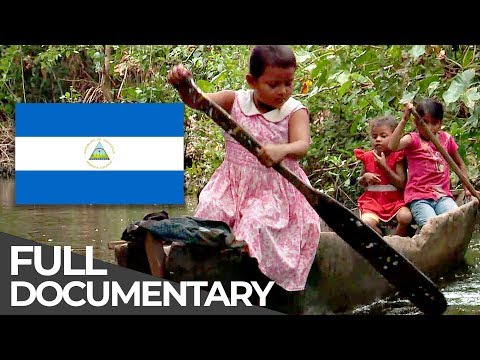
Most Dangerous Ways To School | NICARAGUA | Free Documentary
Every morning, the three sisters Julia, Yulissa and Kenya climb into their dugout in order to row to school. They live on the east coast of Nicaragua, one of the world’s poorest countries, and the youngest of them has just turned five; the oldest is nine. They row across the Rio Escondido. Not only is it one of the largest rivers in the country, it is simultaneously one of the most dangerous routes to school. While they have to watch out for snakes lurking in the trees over the river, the three sisters also struggle against the current and must ensure the dugout does not fill up with water - because it has multiples holes and could sink at any minute. Other classmates do not necessarily have it easier, because they live far from the river, and their journey to school takes them through the deep jungle. One of these classmates is 11-year-old Greyven. His daily trip takes him through the so-called ‘snake field’, in which coral snakes and the infamous boa constrictor reside. On the way to school, the rain drives the snakes from the empty coconuts on the ground; on the way back the afternoon heat, which is over 35 degrees, means that they are lively and belligerent. The daily journey – ashore and to water – to San Mariano’s small village school is an adventure almost unimaginable to us. Every time they undertake this trip, the children expose themselves to life-threatening dangers, all for the chance to have a better future.
Published Sep 18, 2015
Trump's Iran Deadline, Private Credit Worries | Bloomberg Businessweek Daily 4/07/2026
42:29
Bloomberg Television
Trump's Iran Deadline, Private Credit Worries | Bloomberg Businessweek Daily 4/07/2026
On today's episode of Bloomberg Businessweek Daily, Carol Massar and Tim Stenovec speak with Jennifer Welch, Bloomberg Economics Chief Geoeconomics Analyst on the latest about President Trump's looming deadline for Iran. They also speak with im Caron, Morgan Stanley Investment Management Portfolio Solutions Group CIO;  Michael Gross, SLR Capital Partners Co-Founder; and Sastry Durvasula, TIAA Chief Operating, Information and Digital Officer. Chapters: 00:00:00 - Bloomberg Businessweek Daily Begins 00:06:04 - Jennifer Welch, Bloomberg Economics 00:09:30 - Jim Caron, Morgan Stanley Investment Mgmt 00:21:22 - Michael Gross, SLR Capital Partners 00:36:03 - Sastry Durvasula, TIAA -------- Watch Bloomberg Radio LIVE on YouTube Weekdays 7am-6pm ET WATCH HERE: http://bit.ly/3vTiACF Follow us on X: https://twitter.com/BloombergRadio Subscribe to our Podcasts: Bloomberg Daybreak: http://bit.ly/3DWYoAN Bloomberg Surveillance: http://bit.ly/3OPtReI Bloomberg Intelligence: http://bit.ly/3YrBfOi Balance of Power: http://bit.ly/3OO8eLC Bloomberg Businessweek: http://bit.ly/3IPl60i Listen on Apple CarPlay and Android Auto with the Bloomberg Business app: Apple CarPlay: https://apple.co/486mghI Android Auto: https://bit.ly/49benZy Visit our YouTube channels: Bloomberg Podcasts: https://www.youtube.com/bloombergpodcasts Bloomberg Television: https://www.youtube.com/@markets Bloomberg Originals: https://www.youtube.com/bloomberg Quicktake: https://www.youtube.com/@BloombergQuicktake
Published Apr 7, 2026
Most Dangerous Ways To School | PERU | Free Documentary
48:00
Free Documentary
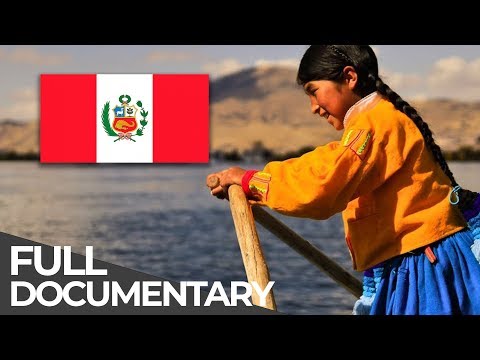
Most Dangerous Ways To School | PERU | Free Documentary
It is early in the morning as Vidal gets himself ready. But before Vidal can brace himself for his dangerous way to school he must take care of his family`s sustenance – like every morning he checks the fishing nets. After work it`s time for a Uro bread and he drinks a Mate tea. Both things, like almost everything else here are made form the totora reeds. The Uros are a people that are very rooting in their tradition. They have even managed to preserve the Pukina, their mother language dating back to the colonial time. After two hours of paddling, Vidal reaches the center of the village. He floats past houses, where a family is building their new island since the old one has began to rot. It is the normal rhythm here. Every three years a new ground under the feet and a new roof above the head needs to be made. The construction begins by cutting the roots of the totora reeds in 30 cm long blocks. Five hundred of these are then tied together with ropes and soaked in the water for three months until they melt into one large block. On top of this block, the family piles totora reeds up to two meters high, until a part of the block sinks in the water and starts to rot. The gases released from this biomass under water produce a buoyant force that causes the new island to swim. After three hours of paddling, Vidal has finally reached the Uro elementary school where he learns to read and write. Here besides his native language, he also learns Spanish. It is not the language of his parents, but at the same time it is his chance of a future outside of his village.
Published Sep 8, 2015
Trump Says Iran Could ‘Die Tonight’ | Balance of Power: Early Edition 4/07/2026
43:56
Bloomberg Television
Trump Says Iran Could ‘Die Tonight’ | Balance of Power: Early Edition 4/07/2026
On the early edition of Balance of Power, Bloomberg Washington Correspondent Kailey Leinz discusses the latest in the Middle East. On today's show, Cohen Group Senior Advisor Jen Gavito, Stonecourt Capital Partner Rick Davis, Harvard Kennedy School Ash Center Visiting Democracy Fellow Jeanne Sheehan Zaino and Democratic Congressman Suhas Subramanyam. Chapters: 00:00:00 - Balance of Power: Early Edition Begins 00:03:55 - Tyler Kendall, Bloomberg News 00:09:47 - Jen Gavito, The Cohen Group 00:20:52 - Jeanne Sheehan Zaino & Rick Davis 00:25:58 - Matt Winkler, Bloomberg News 00:31:54 - Iain Marlow, Bloomberg News 00:37:03 - Rep. Suhas Subramanyam (D) Virginia -------- Watch Bloomberg Radio LIVE on YouTube Weekdays 7am-6pm ET WATCH HERE: http://bit.ly/3vTiACF Follow us on X: https://twitter.com/BloombergRadio Subscribe to our Podcasts: Bloomberg Daybreak: http://bit.ly/3DWYoAN Bloomberg Surveillance: http://bit.ly/3OPtReI Bloomberg Intelligence: http://bit.ly/3YrBfOi Balance of Power: http://bit.ly/3OO8eLC Bloomberg Businessweek: http://bit.ly/3IPl60i Listen on Apple CarPlay and Android Auto with the Bloomberg Business app: Apple CarPlay: https://apple.co/486mghI Android Auto: https://bit.ly/49benZy Visit our YouTube channels: Bloomberg Podcasts: https://www.youtube.com/bloombergpodcasts Bloomberg Television: https://www.youtube.com/@markets Bloomberg Originals: https://www.youtube.com/bloomberg Quicktake: https://www.youtube.com/@BloombergQuicktake
Published Apr 7, 2026
Most Dangerous Ways To School | HIMALAYA (India) | Free Documentary
48:02
Free Documentary
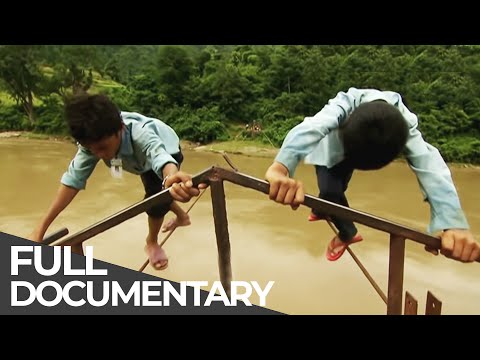
Most Dangerous Ways To School | HIMALAYA (India) | Free Documentary
Twice a year the forbidding journey to the boarding school is necessary. Father Latak, looks to the sky and attempts to predict how the weather will develop. Only when he is sure that no storm is brewing, he starts to prepare the children for the trip over the river. It is a route that is so notorious, that it even has a name: Chadar - the path over the cloak of ice. One last time, his ten year old son Motup, plays in front of their hut. Motup is one of the few kids who regularly leave the village in order to attend one of the the better schools in town. Then the family gets ready for the long trip. The mother has sewn thick wool socks for the father and the children, and Tebean prayers and mantras are recited for protection along the way. Then the trip begins, where the children muss trust completely the experience and skill of their father. The first steps, only a few kilometres until the frozen river, seem easy for the family. But father Latak recognizes immediately that the spring has come early this year and the sun has already began to compromise the ice. This is not a good sign, since the thinner the ice the more dangerous the trip becomes. Latak goes before the children and tests with a stick before each step on the ice. Often the ice cracks a bit, but the ice remains whole. Latak knows that no one should travel the Chadar without a good reason. But the education of the children is a good enough reason to take on the risks involved. He knows that if he goes first and the ice carries his weight, that it will also carry the weight of the children. If it does not, it will be he that will fall in the icy water and not his two children. At the same time, Latak, Motup and the other members of the crew must keep a close eye on the mountains. The massive mountain ranges on both sides of them seem to be a scene form a picture book, peaceful and lordly. But there is danger lurking. At any given time, an avalanche can break out. Many times before people have been caught by avalanches here. In the mean time the sun has already thawed the middle of the river. But since there are steep rocks right and left, Latak must now search for a new path for them to continue on. He leaves Motup behind him and luckily finds a way. It is a 20 cm wide path on the rocks at the edge of the river, and up to ten meters high. They need almost an hour, skipping from rock to rock until they finally reach an area where the river is again covered with ice. Now they must find a place to set up camp as soon as possible before it becomes dark and the temperatures sink to as low as -30 degrees Celsius. Latak knows a cave where they will be protected and finally be able to get some rest. They must gather their strength because the most dangerous part of the Chadar still lies before them. The ice is almost completely melted. Only a 50 cm wide strip borders right and left the ice-cold water, making the river absolutely impassible. Rocky overhangs above the ice block the way. Father and son must now crawl its way to school. Father Latak tests his way over the ice on his belly. After any progress made, he pulls his son by their hands to him. There are countless dangerous situations that make this way to school so unpredictable. But after four days it is over, they have reached their goal; the city of Leh and the school.
Published Sep 7, 2015